
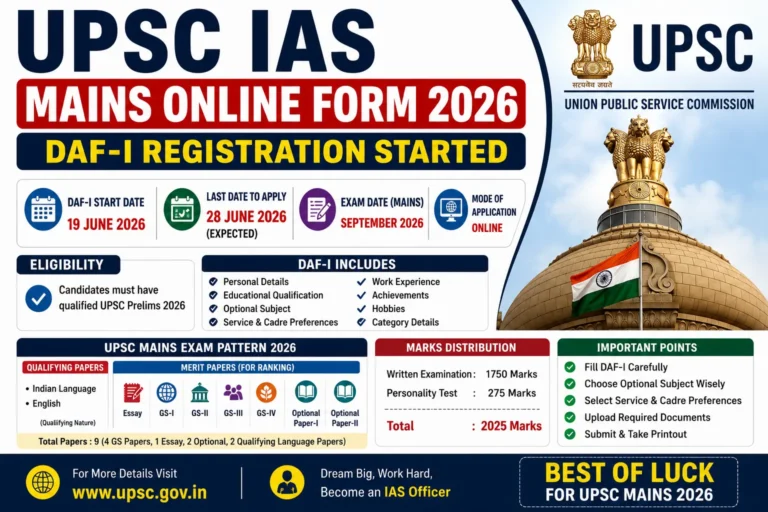
UPSC IAS Mains Online Form 2026: DAF-I Registration Started, Eligibility, Exam Date, Selection Process & Complete Details
UPSC IAS Mains Online Form 2026
The Union Public Service Commission (UPSC) has released the Civil Services Preliminary Examination 2026 Result. Candidates who have successfully qualified in the Preliminary Examination are now eligible to fill out the Detailed Application Form-I (DAF-I) for the UPSC Civil Services Main Examination 2026.
The UPSC Civil Services Examination is one of the most prestigious competitive examinations in India and is conducted for recruitment to various services such as the Indian Administrative Service (IAS), Indian Police Service (IPS), Indian Foreign Service (IFS), Indian Revenue Service (IRS), and several other Group A and Group B services.
Candidates who have qualified for the Preliminary Examination must complete the DAF-I registration process within the prescribed timeline to appear in the Mains Examination.
UPSC IAS Mains 2026 Overview
| Particulars | Details |
|---|---|
| Exam Name | Civil Services Examination (CSE) 2026 |
| Conducting Authority | Union Public Service Commission (UPSC) |
| Examination Level | National Level |
| Application Form | Detailed Application Form-I (DAF-I) |
| Application Mode | Online |
| Qualification Required | UPSC Prelims 2026 Qualified |
| Exam Mode | Offline (Written Examination) |
| Official Website | UPSC Official Portal |
| Selection Process | Prelims, Mains & Interview |
UPSC IAS Mains 2026 Latest Update
UPSC has announced the Civil Services Preliminary Examination Result 2026. Candidates who cleared the Preliminary Examination are required to submit the Detailed Application Form-I (DAF-I) to participate in the Main Examination.
The DAF-I is an important document because the information submitted in this form is used during the Mains Examination process and later during the Personality Test (Interview).
Candidates are advised to carefully fill in all details and upload the required documents before the last date.
Important Dates
| Event | Date |
|---|---|
| UPSC Prelims Exam 2026 | Completed |
| Prelims Result Declaration | June 2026 |
| DAF-I Registration Start Date | June 2026 |
| Last Date for DAF-I Submission | June 2026 |
| UPSC Mains Exam Date | September 2026 |
| Admit Card Release | Before Examination |
| Mains Result | To Be Announced |
| Interview Schedule | After Mains Result |
Candidates should regularly check the UPSC website for official updates regarding important dates.
Haryana HSSC Group D CET Online Form 2026
What is UPSC DAF-I?
DAF-I stands for Detailed Application Form-I.
After qualifying for the Preliminary Examination, candidates are required to submit this form online. It contains detailed information about the candidate’s educational background, category, service preferences, optional subject, employment history, achievements, hobbies, and other personal details.
The information provided in DAF-I plays a crucial role during the Interview stage, as members of the Interview Board often ask questions based on the candidate’s submitted profile.
Eligibility for UPSC IAS Mains 2026
Only candidates who have qualified in the UPSC Civil Services Preliminary Examination 2026 are eligible to fill the DAF-I and appear in the Main Examination.
Educational Qualification
- Candidates must possess a Bachelor’s Degree from a recognized university.
- Final-year students who qualified for Prelims and meet UPSC conditions may also be eligible as per official rules.
Nationality
For IAS and IPS:
- Candidate must be a citizen of India.
For certain other services:
- Citizens of India
- Subjects of Nepal
- Subjects of Bhutan
- Certain categories of Tibetan refugees and persons of Indian origin as per UPSC guidelines
UPSC IAS Mains Application Fee
Generally, no separate application fee is charged for DAF-I from candidates who have already applied for the Civil Services Examination.
Candidates should verify fee-related details through the official notification.
Documents Required for UPSC DAF-I
Candidates should keep the following documents ready while filling out the application form:
Personal Documents
- Aadhaar Card
- PAN Card (if applicable)
- Passport (if available)
- Valid Identity Proof
Educational Documents
- Class 10 Certificate
- Class 12 Certificate
- Graduation Mark Sheets
- Degree Certificate
Reservation Documents
- SC Certificate
- ST Certificate
- OBC Certificate
- EWS Certificate
- PwBD Certificate
Other Documents
- Passport-size Photograph
- Signature
- Photo Identity Card
- Service Certificate (if applicable)
How to Fill UPSC IAS Mains Online Form 2026?
Candidates can complete the application process by following these steps:
Step 1
Visit the UPSC official website.
Step 2
Click on the DAF-I Registration Link.
Step 3
Login using Registration ID and Password.
Step 4
Verify personal details.
Step 5
Enter educational qualifications.
Step 6
Select the Optional Subject.
Step 7
Fill service preferences carefully.
Step 8
Choose cadre preferences where applicable.
Step 9
Upload required documents.
Step 10
Review all information and submit the application form.
Step 11
Take a printout of the submitted form for future reference.
UPSC IAS Mains Examination Pattern 2026
The UPSC Civil Services Main Examination consists of nine papers.
Qualifying Papers
Paper-A
Indian Language
Paper-B
English Language
These papers are qualifying in nature.
Merit Ranking Papers
Paper-I
Essay
Paper-II
General Studies-I
Paper-III
General Studies-II
Paper-IV
General Studies-III
Paper-V
General Studies-IV
Paper-VI
Optional Subject Paper-I
Paper-VII
Optional Subject Paper-II
Only marks obtained in merit papers are considered for final ranking.
UPSC Mains Marks Distribution
| Stage | Marks |
|---|---|
| Written Examination | 1750 |
| Personality Test | 275 |
| Total Marks | 2025 |
The final merit list is prepared based on the combined score of the Mains Examination and Personality Test.
Optional Subjects in UPSC Mains
Candidates can choose one optional subject from the UPSC-approved list.
Popular optional subjects include:
- Geography
- History
- Political Science
- Sociology
- Public Administration
- Psychology
- Anthropology
- Economics
- Philosophy
- Mathematics
- Agriculture
- Literature Subjects
Candidates should select an optional subject according to their academic background, interest, and preparation strategy.
Service Preferences in UPSC
During DAF-I submission, candidates must indicate their preferred services.
Popular services include:
- Indian Administrative Service (IAS)
- Indian Police Service (IPS)
- Indian Foreign Service (IFS)
- Indian Revenue Service (IRS)
- Indian Audit and Accounts Service (IAAS)
- Indian Defence Accounts Service (IDAS)
- Indian Postal Service (IPoS)
- Railway Services
Candidates should carefully arrange their preferences because service allocation depends on merit rank, category, and preferences submitted.
Cadre Preference
Candidates applying for IAS and IPS are also required to provide cadre preferences.
Examples include:
- AGMUT Cadre
- Haryana Cadre
- Punjab Cadre
- Rajasthan Cadre
- Uttar Pradesh Cadre
- Madhya Pradesh Cadre
- Maharashtra Cadre
- Tamil Nadu Cadre
Cadre allocation is subject to UPSC and Government of India rules.
UPSC IAS Salary Structure
IAS officers receive an attractive salary along with various allowances and benefits.
| Position | Basic Pay |
|---|---|
| Junior Scale | ₹56,100 |
| Senior Time Scale | ₹67,700 |
| Junior Administrative Grade | ₹78,800 |
| Selection Grade | ₹1,23,100 |
| Additional Secretary | ₹2,05,400 |
| Cabinet Secretary | ₹2,50,000 |
Additional benefits include:
- House Rent Allowance (HRA)
- Travel Allowance (TA)
- Medical Facilities
- Official Accommodation
- Government Vehicle (as per post)
UPSC IAS Selection Process 2026
The Civil Services Examination is conducted in three stages:
Stage 1: Preliminary Examination
Objective-type examination used for screening candidates.
Stage 2: Main Examination
Descriptive written examination.
Stage 3: Personality Test (Interview)
Candidates who qualify the Mains Examination are called for the Interview.
Final selection is based on marks obtained in the Mains Examination and Interview.
Preparation Tips for UPSC Mains 2026
Focus on Answer Writing
Regular answer-writing practice is essential for scoring high marks.
Read Current Affairs Daily
Stay updated with national and international events.
Prepare Notes
Maintain concise notes for quick revision.
Revise Regularly
Multiple revisions improve retention and confidence.
Solve Previous Year Papers
Analyze previous papers to understand the exam pattern and question trends.
Strengthen Optional Subject
Optional papers contribute significantly to the final score.
Common Mistakes While Filling DAF-I
Many candidates make mistakes during form submission.
Avoid the following:
- Incorrect personal details
- Wrong category information
- Incorrect optional subject selection
- Improper document upload
- Last-minute submission
- Wrong service preference order
Always verify all details before final submission.
Why DAF-I is Important?
The DAF-I is more than just an application form.
It provides a complete profile of the candidate and becomes an important reference document during the Personality Test.
Interview Board members may ask questions related to:
- Educational background
- Hobbies
- Work experience
- Home state
- Achievements
- Academic interests
Therefore, candidates should fill the form carefully and honestly.
Frequently Asked Questions (FAQs)
Q1. Who can fill the UPSC IAS Mains Online Form 2026?
Only candidates who have qualified in the UPSC Civil Services Preliminary Examination 2026.
Q2. What is DAF-I?
DAF-I stands for Detailed Application Form-I, which must be submitted by candidates qualified for the Mains Examination.
Q3. Is DAF-I mandatory?
Yes, submission of DAF-I is mandatory for appearing in the UPSC Main Examination.
Q4. What is the mode of UPSC Mains Examination?
The examination is conducted in offline descriptive mode.
Q5. How many papers are there in UPSC Mains?
There are nine papers in the Main Examination.
Q6. What are the total marks in UPSC Mains and Interview?
The total marks are 2025 (1750 for Mains and 275 for Interview).
Q7. Can candidates edit DAF-I after submission?
Generally, modifications may not be allowed after final submission. Candidates should verify all details before submitting the form.
Q8. Is service preference important?
Yes, service preference plays a major role in final service allocation.
Conclusion
The UPSC IAS Mains Online Form 2026 (DAF-I) is an important step for candidates who have qualified for the Civil Services Preliminary Examination. Candidates must carefully complete the registration process, upload the required documents, and submit accurate information. Since the DAF-I serves as a key reference during the Personality Test, every detail should be filled thoughtfully. Aspirants are advised to complete the application process well before the deadline and continue focused preparation for the Main Examination.
Apply Online:-
Application Login:-
Download Notification:-
Click Here
Join CityJobAlert Channel
Join CityJobAlert Channel
Official Website:-

Aman Saini
Aman Saini has experience in creating educational and government job-related content. He focuses on delivering accurate recruitment updates, exam notifications, admit cards, results, and career guidance for students and job aspirants.